Bhagavad Gita chapter summary: all 18 chapters
The Bhagavad Gita has 18 chapters. Here is what each one is about in a few plain sentences, with the main idea and one verse to look for.
How to use this page: read a chapter's summary before you read the chapter, so you know where it is heading, or after, to check what you took from it. The verse numbers are chapter.verse, so 2.47 is chapter 2, verse 47.
The 18 chapters of the Bhagavad Gita, by name
Every chapter has a traditional Sanskrit name, and all 18 end in "yoga", a word that here means a path or a discipline (see the short glossary). The names below are written without diacritics so they are easy to search for, and the right-hand column says what each chapter is about in plain words.
| No. | Chapter name | In plain words |
|---|---|---|
| 1 | Arjuna Vishada Yoga | Arjuna's despair |
| 2 | Sankhya Yoga | The eternal self and steady wisdom |
| 3 | Karma Yoga | The yoga of action |
| 4 | Jnana Karma Sannyasa Yoga | Knowledge and action |
| 5 | Karma Sannyasa Yoga | Renunciation and action |
| 6 | Dhyana Yoga | Meditation |
| 7 | Jnana Vijnana Yoga | Knowledge and realization |
| 8 | Akshara Brahma Yoga | The imperishable |
| 9 | Raja Vidya Raja Guhya Yoga | The royal knowledge, the royal secret |
| 10 | Vibhuti Yoga | Divine glories |
| 11 | Vishvarupa Darshana Yoga | The universal form |
| 12 | Bhakti Yoga | The yoga of devotion |
| 13 | Kshetra Kshetrajna Vibhaga Yoga | The field and the knower of the field |
| 14 | Gunatraya Vibhaga Yoga | The three modes of nature |
| 15 | Purushottama Yoga | The supreme person |
| 16 | Daivasura Sampad Vibhaga Yoga | Divine and demonic qualities |
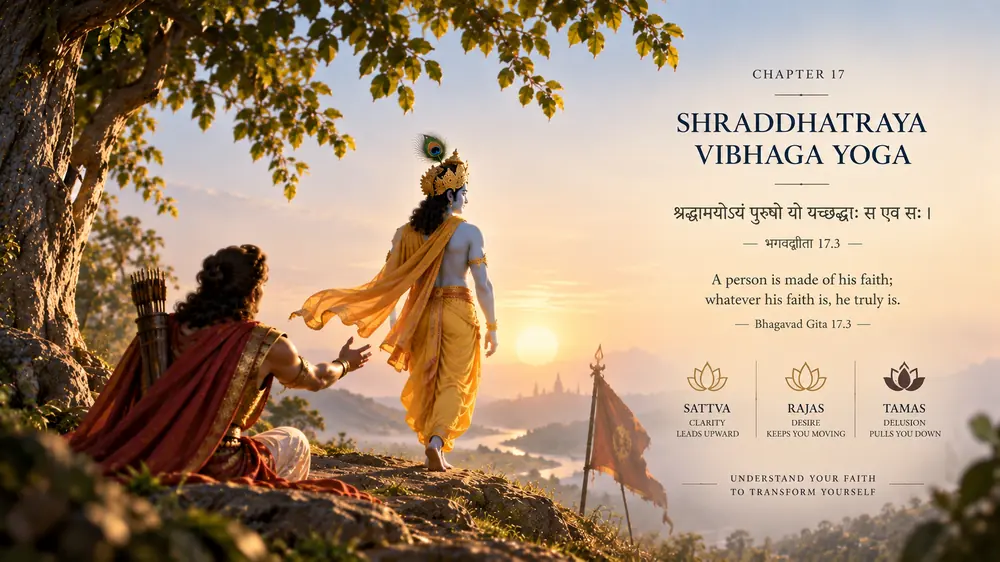
| 17 | Shraddhatraya Vibhaga Yoga | The three kinds of faith |
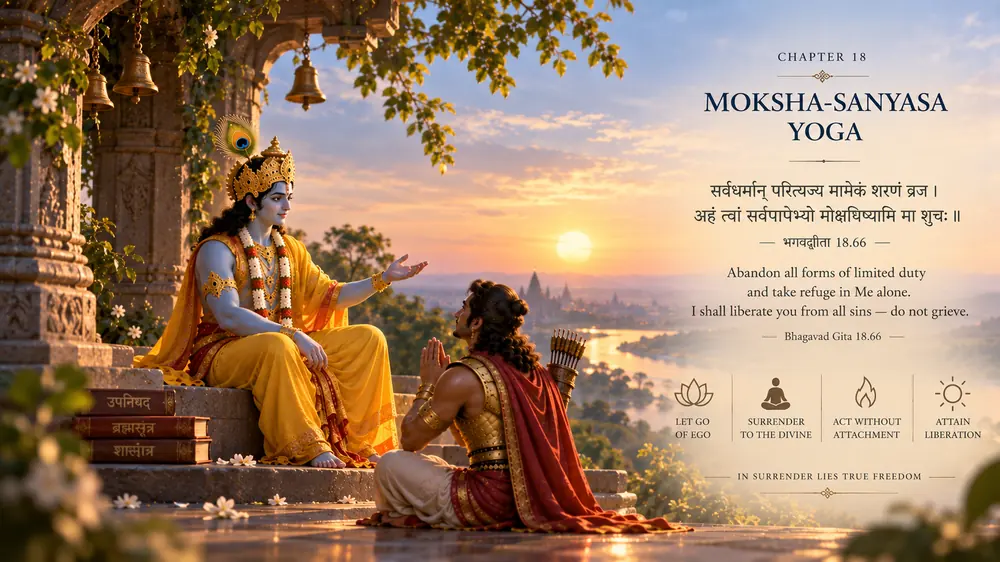
| 18 | Moksha Sannyasa Yoga | Liberation through surrender |
Chapter 1 of 18
Chapter 1: Arjuna Vishada Yoga
Arjuna's despair
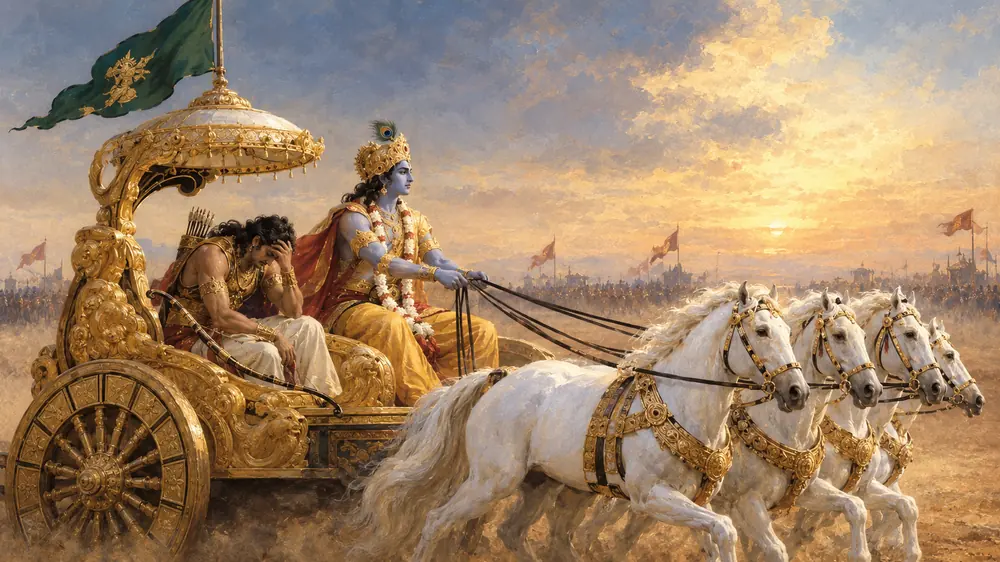
The blind king Dhritarashtra asks his adviser Sanjaya what is happening at Kurukshetra, where two armies of one family face each other. Arjuna, the great archer, asks his charioteer Krishna to drive between the lines. Seeing teachers, elders and cousins on both sides, he is overcome with grief, puts down his bow and says he will not fight.
Main idea: The Gita does not begin with a lecture. It begins with a person who is stuck, and it takes that seriously.
Look for: 1.47, where Arjuna sinks down in his chariot and lets go of his bow.
Chapter 2 of 18
Chapter 2: Sankhya Yoga
the eternal self and steady wisdom
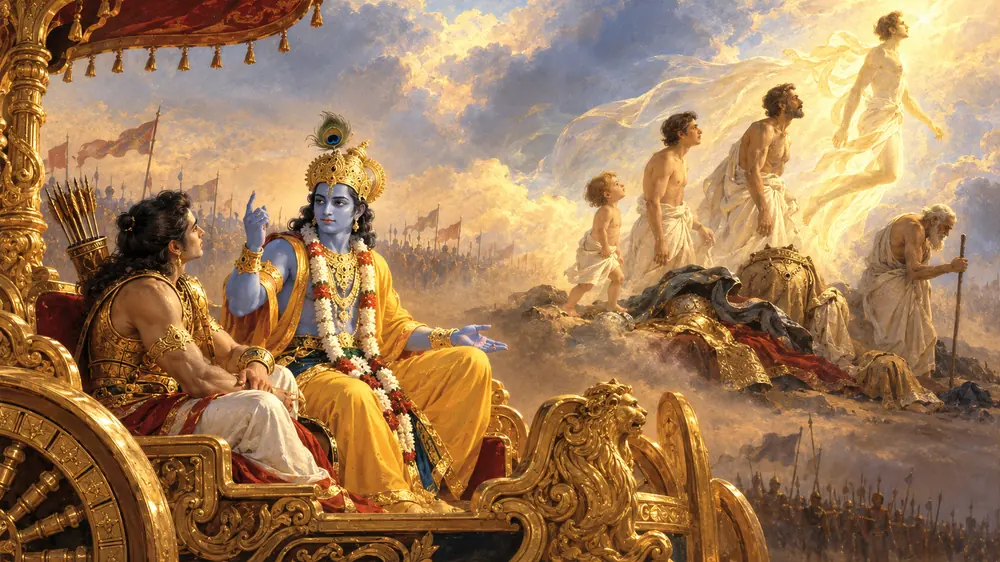
Krishna's teaching proper begins here, at verse 11. He tells Arjuna that the wise do not grieve, because the self is not born and does not die; only the body changes. He then introduces acting without clinging to the result, and describes the steady mind of a person who is not thrown around by pleasure and pain.
Main idea: Separate what you control, your effort, from what you do not, the outcome.
Look for: 2.47 on action and its results, and 2.54 to 2.72 on the steady mind.
Chapter 3 of 18
Chapter 3: Karma Yoga
the yoga of action
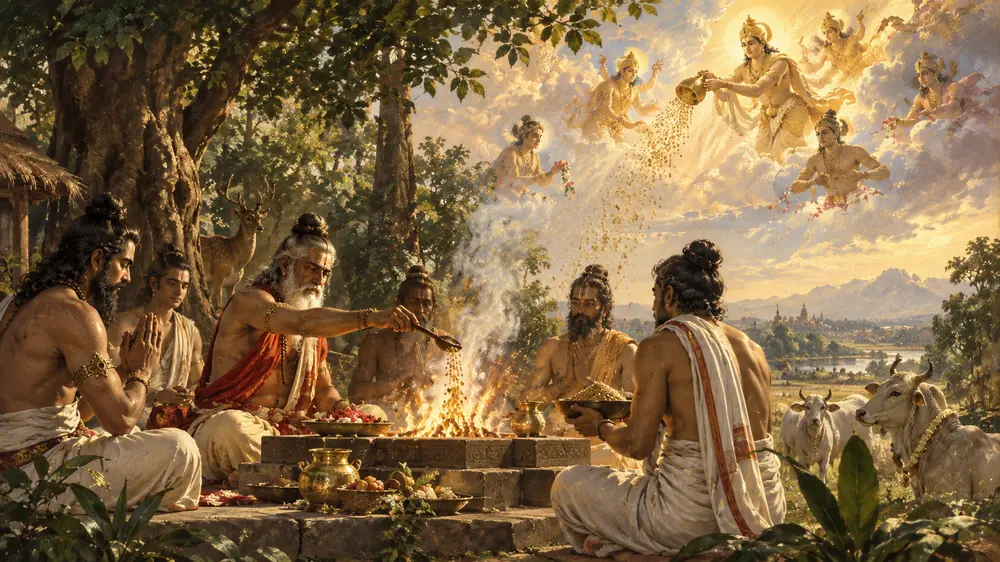
Arjuna asks why he should act at all if knowledge is higher. Krishna answers that nobody can stop acting for even a moment, so the question is how to act. Do the work that is yours to do, as an offering, without being ruled by desire and anger.
Main idea: Action is not the problem. Being driven by wanting and by anger is.
Look for: 3.35 on doing your own duty imperfectly rather than another's well, and 3.37 on desire and anger.
Chapter 4 of 18
Chapter 4: Jnana Karma Sannyasa Yoga
knowledge and action
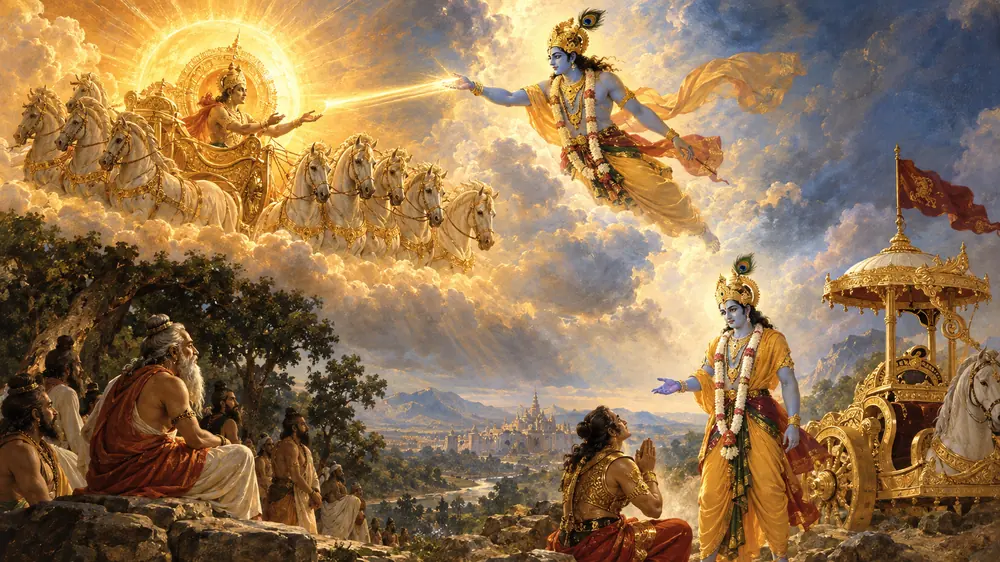
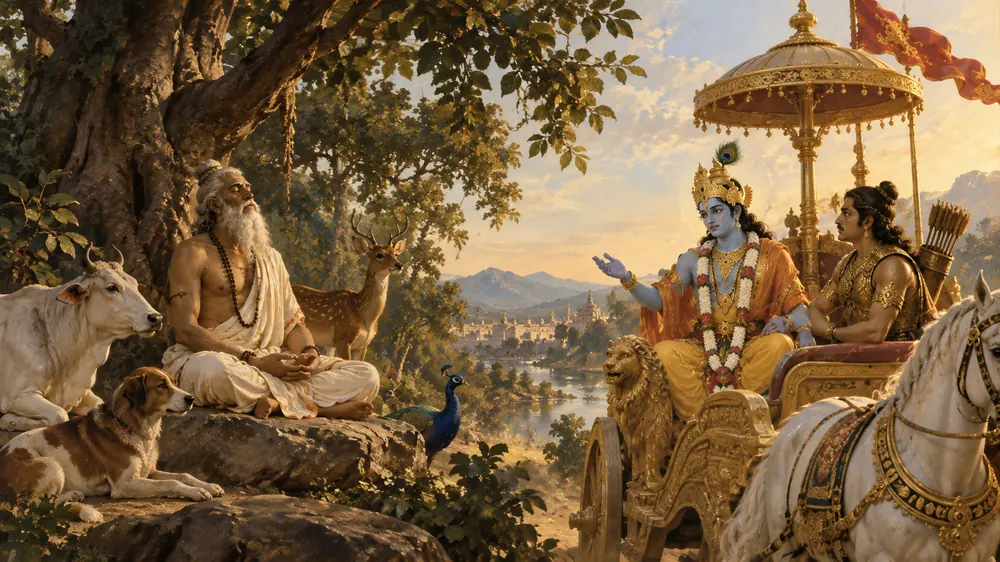
Krishna says this teaching is ancient and had been lost over time. He explains that whenever right living declines he comes into the world to restore it, and he describes how a person can act fully without being bound by the action. The chapter also praises knowledge as the purest of offerings and warns about the doubting mind.
Main idea: Knowing why you act changes what the action does to you.
Look for: 4.7 and 4.8 on the return of balance, and 4.33 on the offering of knowledge.
Chapter 5 of 18
Chapter 5: Karma Sannyasa Yoga
renunciation and action
Arjuna asks which is better, giving up action or acting selflessly. Krishna says both lead to the goal, but that selfless action is the easier path to reach it. The one who acts without attachment is untouched by the action, like a lotus leaf that water does not wet, and sees all beings with the same eye.
Main idea: Inner renunciation matters more than leaving the world.
Look for: 5.10 on the lotus leaf and 5.18 on seeing everyone equally.
Chapter 6 of 18
Chapter 6: Dhyana Yoga
meditation
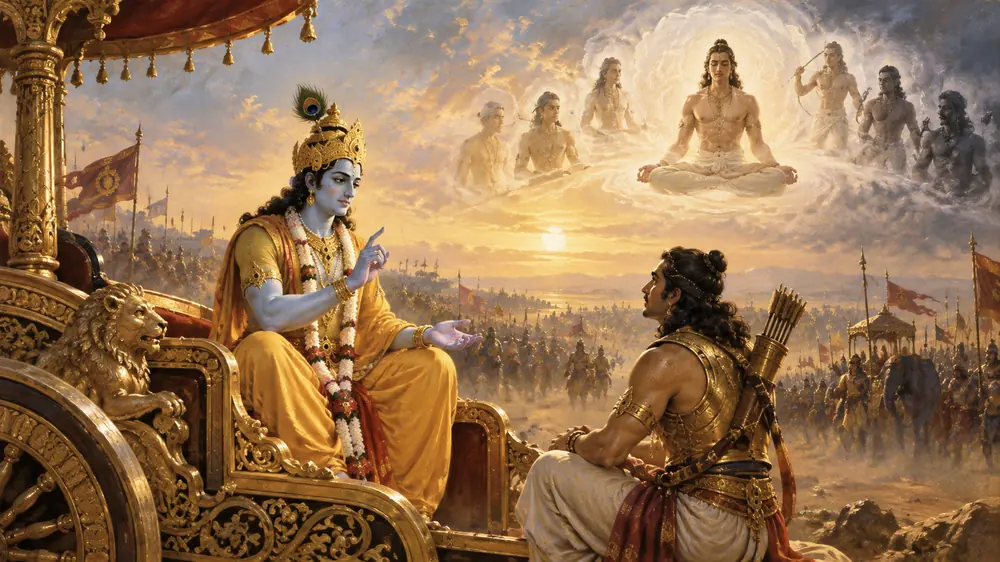
Krishna describes how to practise meditation: a steady seat, moderation in food, sleep and effort, and a mind brought gently back each time it wanders. Arjuna admits the mind seems as hard to hold as the wind. Krishna agrees it is hard but says practice and detachment can steady it, and that no sincere effort is ever wasted.
Main idea: The mind can be your friend or your enemy, and training decides which.
Look for: 6.5 and 6.6 on the mind as friend or enemy, and 6.34 to 6.35 on the restless mind.
Chapter 7 of 18
Chapter 7: Jnana Vijnana Yoga
knowledge and realization
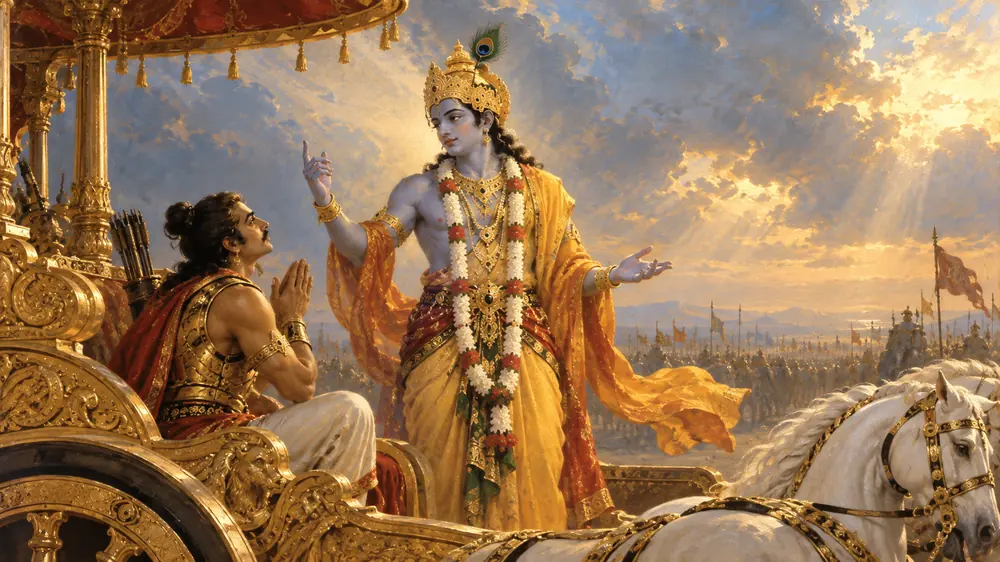
Krishna begins to speak about his own nature. Everything that exists, he says, is made of a lower nature (matter) and a higher nature (life), and all of it is strung on him like beads on a thread. He describes four kinds of people who turn to the divine: the distressed, the seekers of knowledge, the seekers of wealth, and the wise.
Main idea: Behind the variety of the world there is one connecting thread.
Look for: 7.7 on the beads on a thread and 7.16 on the four kinds of seekers.
Chapter 8 of 18
Chapter 8: Akshara Brahma Yoga
the imperishable
Arjuna asks a series of direct questions about Brahman, the self and action. Krishna answers, and then turns to death: whatever a person holds in mind at the end tends to be where they go, so the practice is to keep the mind steady on the highest throughout life. The chapter closes with a vast picture of cosmic cycles of creation and dissolution.
Main idea: What you turn your mind to over a lifetime becomes what you turn to at the end.
Look for: 8.5 to 8.7 on remembrance at the end of life.
Chapter 9 of 18
Chapter 9: Raja Vidya Raja Guhya Yoga
the royal knowledge, the royal secret
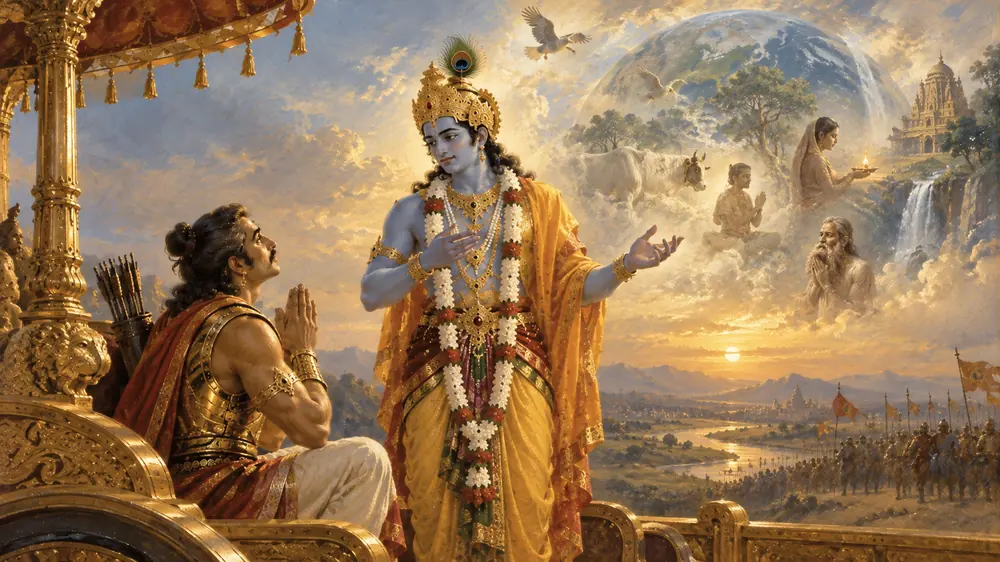
Krishna calls this the most direct teaching. The whole world rests in him though he is not limited by it. The chapter is also one of the warmest: devotion does not need anything grand, and a leaf, a flower, a fruit or water offered with love is accepted, and whatever you do can be offered the same way.
Main idea: The size of an offering matters far less than the feeling behind it.
Look for: 9.26 on the leaf and the flower, and 9.27 on offering everything you do.
Chapter 10 of 18
Chapter 10: Vibhuti Yoga
divine glories
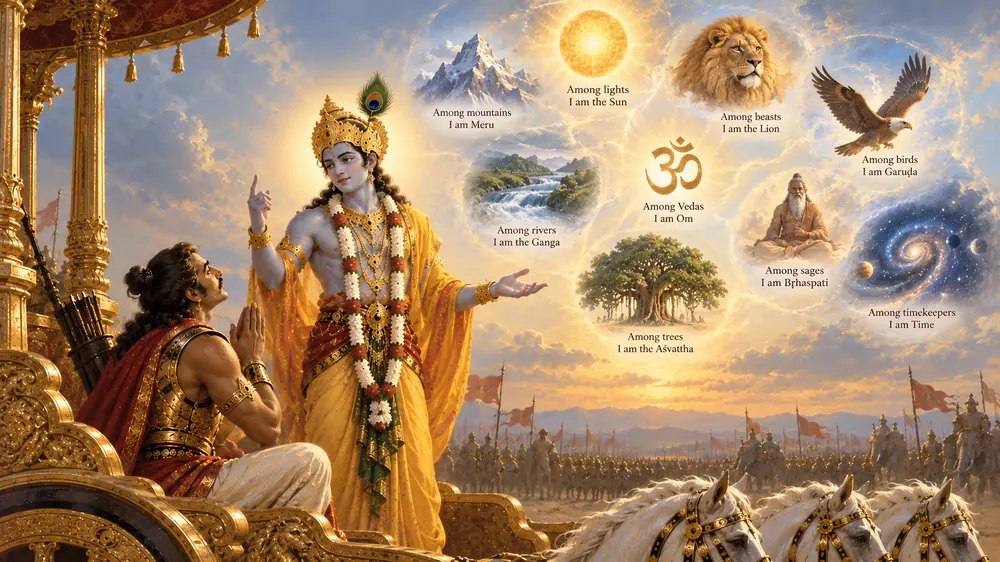
Arjuna asks where he should look to see the divine. Krishna gives a long list: among mountains, the Himalaya or Meru; among lights, the sun; among rivers, the Ganga; among sacred syllables, Om. It is a way of training attention to notice greatness wherever it appears.
Main idea: The divine is not somewhere else. It shows up in the best of everything.
Look for: 10.20 on the self seated in every heart.
Chapter 11 of 18
Chapter 11: Vishvarupa Darshana Yoga
the universal form
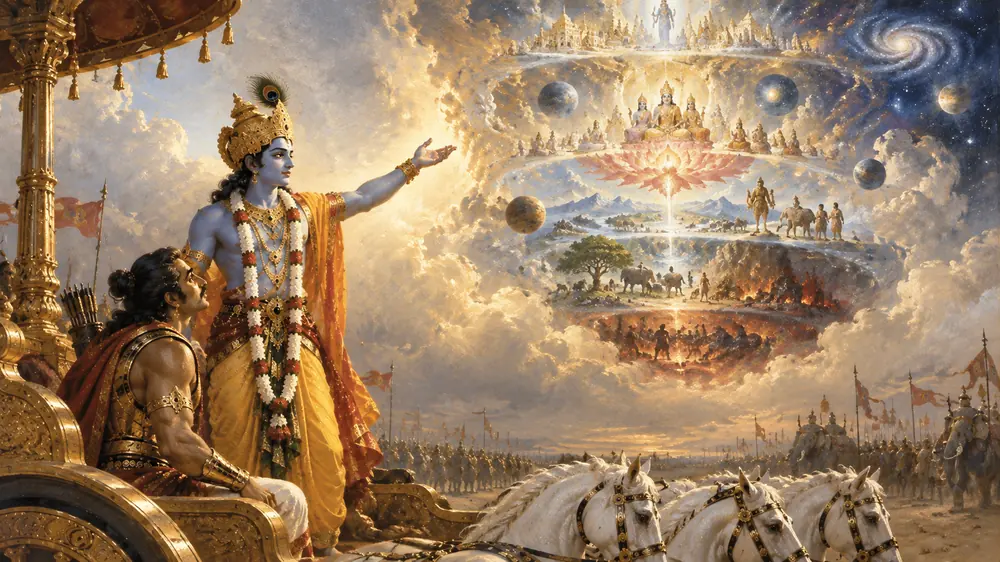
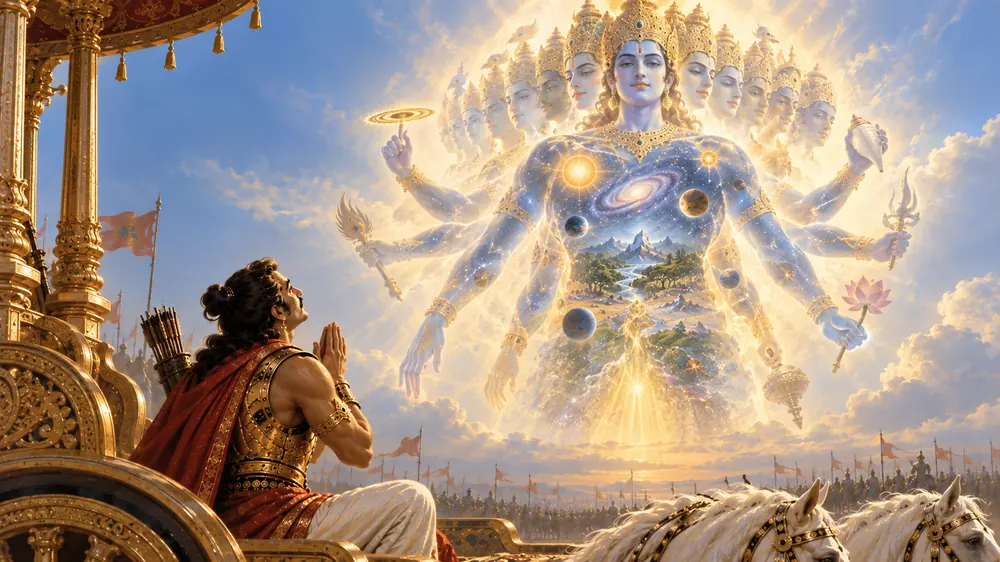
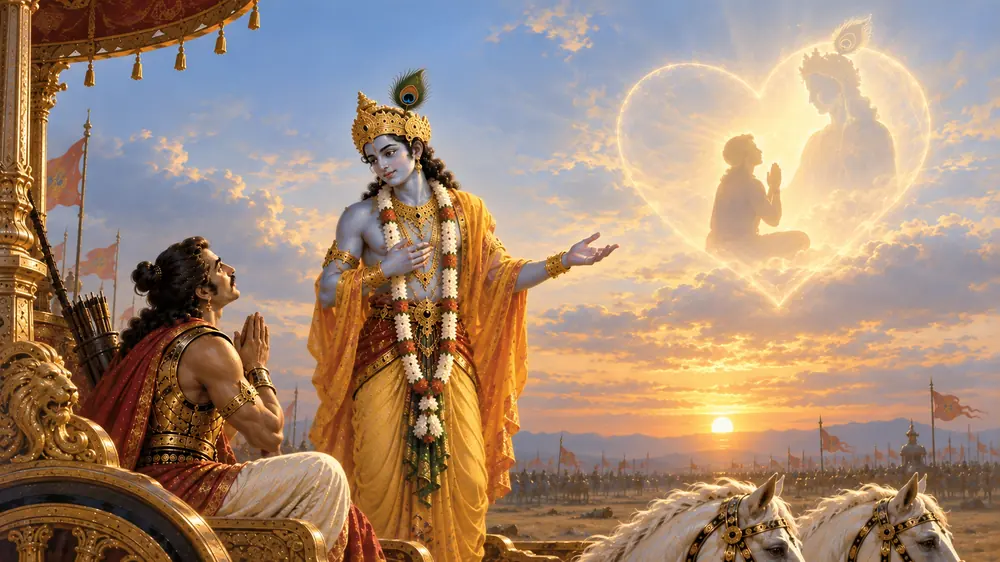
Arjuna asks to see Krishna's cosmic form, and Krishna gives him the sight to bear it. Arjuna sees everything, all beings and all time, within one vast form, and is shaken by awe and fear. Krishna says he is Time, which brings everything to its end, and Arjuna begs to see the gentle, familiar form again.
Main idea: The person beside you on the chariot is also the whole. Both are true.
Look for: 11.32 on Time, and 11.45 to 11.46 on Arjuna asking to see the familiar form again.
Chapter 12 of 18
Chapter 12: Bhakti Yoga
the yoga of devotion
Arjuna asks who is better established: those who worship a personal form with devotion, or those who meditate on the unmanifest. Krishna says both reach the goal, but devotion to a personal form is easier for embodied beings. He gives a ladder of practices for people at different points, then describes the qualities of a person dear to him: kind, free of hatred, even in pain and pleasure.
Main idea: Devotion is a practical path, not only a feeling.
Look for: 12.13 to 12.19, a portrait of a person who is at peace.
Chapter 13 of 18
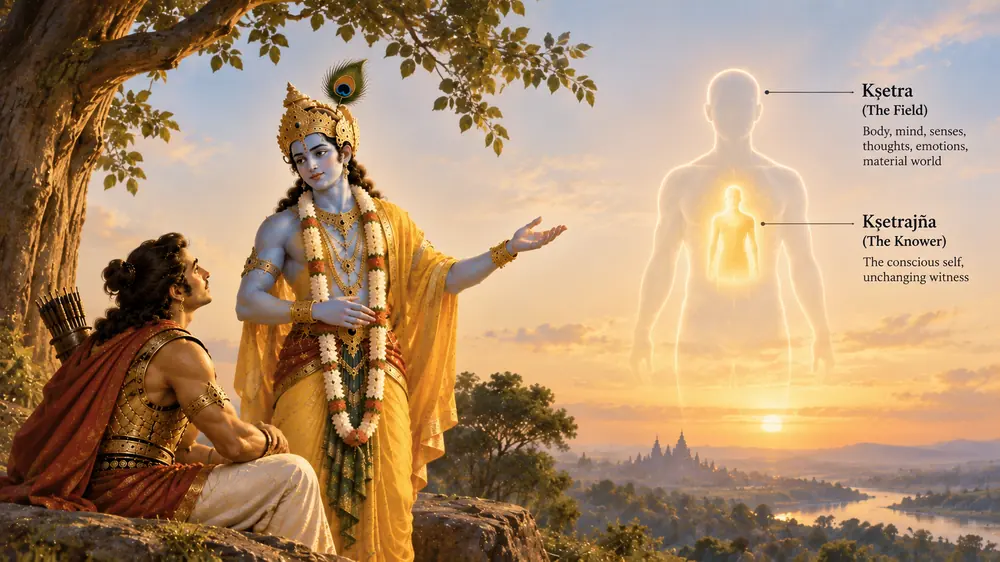
Chapter 13: Kshetra Kshetrajna Vibhaga Yoga
the field and the knower of the field
Krishna calls the body the field and the self the knower of the field. He lists the qualities that make up real knowledge, among them humility, non-violence, patience and steadiness, and explains that action belongs to nature while the self is the witness. The one who sees the same divine presence in all beings does not harm themselves by harming others.
Main idea: You are not only what happens in the body and mind. You are the one aware of it.
Look for: 13.1 and 13.2 on the field and the knower, and 13.27 and 13.28 on seeing the same in all beings.
Chapter 14 of 18
Chapter 14: Gunatraya Vibhaga Yoga
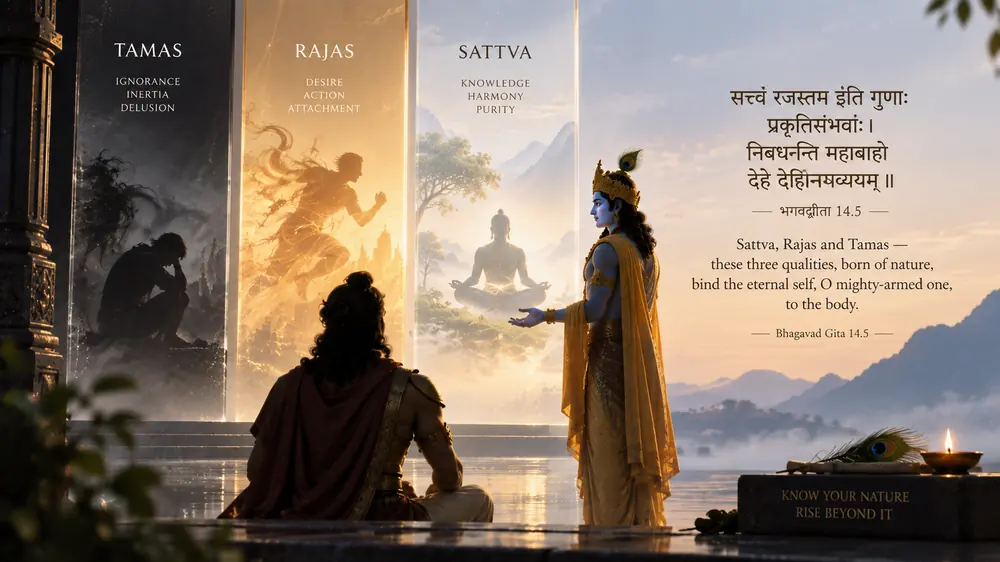
the three modes of nature
Everything in nature is made of three qualities: sattva (clarity and harmony), rajas (passion and restless activity) and tamas (inertia and confusion). Each binds a person in its own way, and each pulls harder at different times. Krishna describes how to recognise them in yourself and what it means to rise above all three.
Main idea: A useful way to observe your own state of mind, and to notice which quality is running the show.
Look for: 14.5 to 14.9 on how each quality binds, and 14.22 to 14.25 on the person beyond them.
Chapter 15 of 18
Chapter 15: Purushottama Yoga
the supreme person
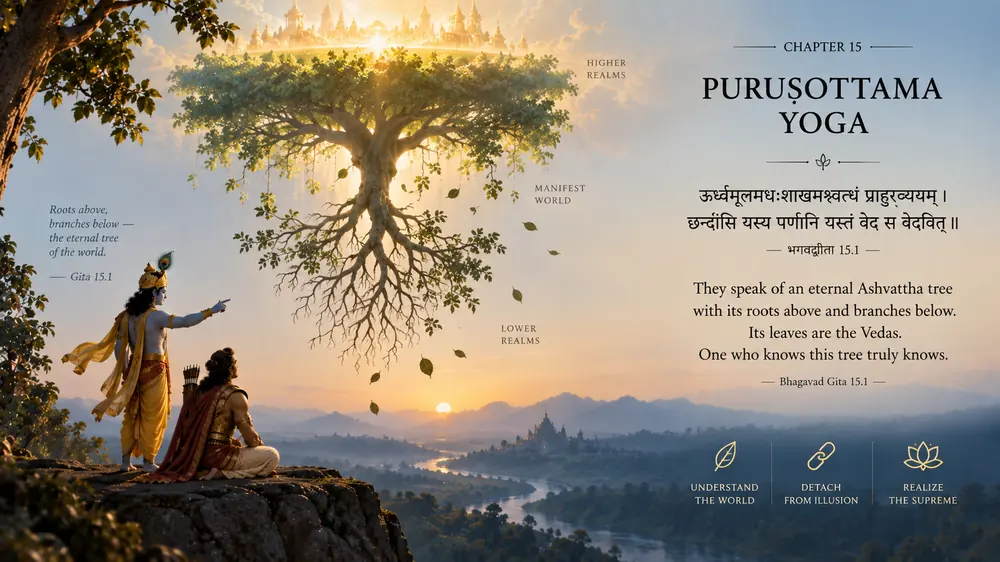
The chapter opens with a striking image: a tree with its roots above and its branches below, whose leaves are the sacred hymns. Krishna says this tree of worldly life must be cut with the strong axe of detachment. He then speaks of the highest person, beyond both the perishable and the imperishable, and how knowing this frees a person from confusion.
Main idea: Detachment is not coldness. It is what lets you leave the tangle without being ruled by it.
Look for: 15.1 on the tree with its roots above, and 15.15 on the divine seated in every heart.
Chapter 16 of 18
Chapter 16: Daivasura Sampad Vibhaga Yoga
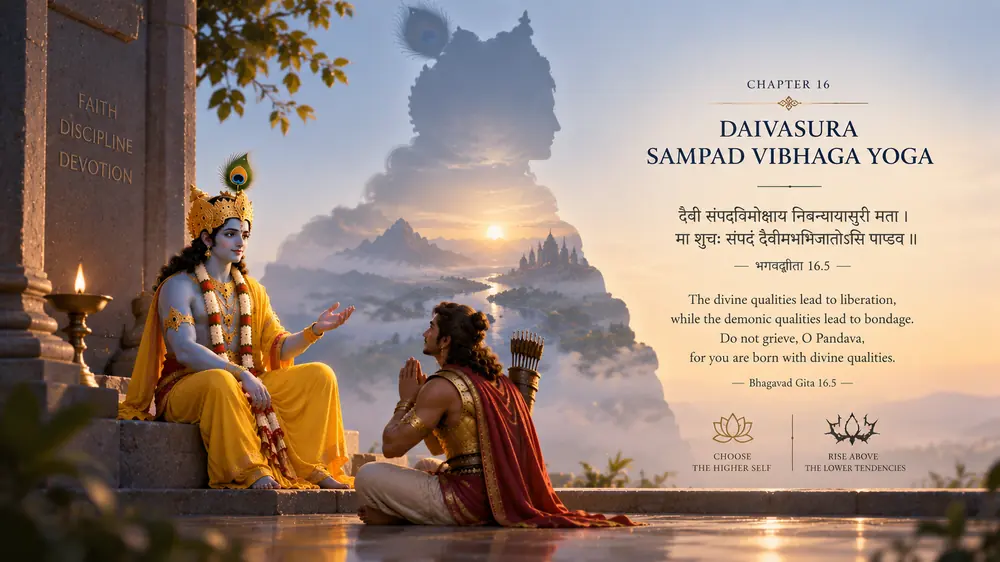
divine and demonic qualities
Krishna lists the qualities of a divine nature: fearlessness, purity of heart, charity, self-control, truthfulness, gentleness, and freedom from anger. He sets them against the qualities of a demonic nature: arrogance, pride, harshness and ignorance. The chapter names three gates that lead a person down, desire, anger and greed, and says to guard against them.
Main idea: A short checklist for character, and the three habits that undo it.
Look for: 16.1 to 16.3 on the divine qualities and 16.21 on the three gates.
Chapter 17 of 18
Chapter 17: Shraddhatraya Vibhaga Yoga
the three kinds of faith
Arjuna asks about people who act with faith but ignore the scriptures. Krishna answers that faith itself comes in three kinds, following the three qualities, and shows how it appears in what people eat, how they worship, what discipline they take up and how they give. The chapter ends with the sacred phrase Om Tat Sat.
Main idea: Faith shapes behaviour, and behaviour shows what kind of faith is at work.
Look for: 17.3 on faith taking the shape of the person, and 17.14 to 17.16 on discipline of body, speech and mind.
Chapter 18 of 18
Chapter 18: Moksha Sannyasa Yoga
liberation through surrender
The longest chapter gathers everything together. Krishna clarifies renunciation and giving up the fruits of action, goes over the three qualities once more, and speaks about one's own duty. Then he gives what he calls the most secret teaching: let go and take refuge in him alone, and do not grieve. Arjuna says his doubt is gone and he will act.
Main idea: After all the teaching, the invitation is to act, with the weight of the outcome put down.
Look for: 18.66 on surrender, 18.73 where Arjuna's doubt clears, and 18.78, the last verse.
How the chapters fit together
Chapters 1 and 2 set up the problem and give the first answer. Chapters 3 to 6 deal with action and the steady mind. Chapters 7 to 12 turn to the nature of the divine and to devotion. Chapters 13 to 18 look at the field and the knower, the three qualities of nature, character and faith, and then pull everything together.
One traditional way of dividing the book gives chapters 1 to 6 to the path of action, chapters 7 to 12 to devotion and chapters 13 to 18 to knowledge. Other teachers divide it differently, and many readers find the ideas run through all 18 chapters instead of staying in one section.
New to all of this? Start with the beginner's guide, then use the daily reading plan.
Want to see how a verse reads in plain English? Try the six famous verses explained, or read what the Gita is about for the story around these chapters. For a scholarly overview of the whole text, see Wikipedia's article on the Bhagavad Gita.
In the Kanha app, chapter 1 and the opening of chapter 2 are told as a short illustrated story, and the verse-by-verse cards run from 2.11 to 18.78.
More guides
- Bhagavad Gita for beginners What it is, where to start, which translation to pick, and a first month of reading.
- How to read the Bhagavad Gita How many verses a day, how long it takes at each pace, and what to do when you fall behind.
- Bhagavad Gita in simple English Six famous verses in plain English, each with a short explanation of what it means.
- Benefits of reading it daily What daily reading can realistically give you, and what it cannot.
- What the Bhagavad Gita is about The story, the speakers, and the main ideas: duty, the self, action, devotion and surrender.
- Gita Jayanti 2026 The date, what the day marks, and a chapter-a-day plan to read the whole Gita by 20 December.